
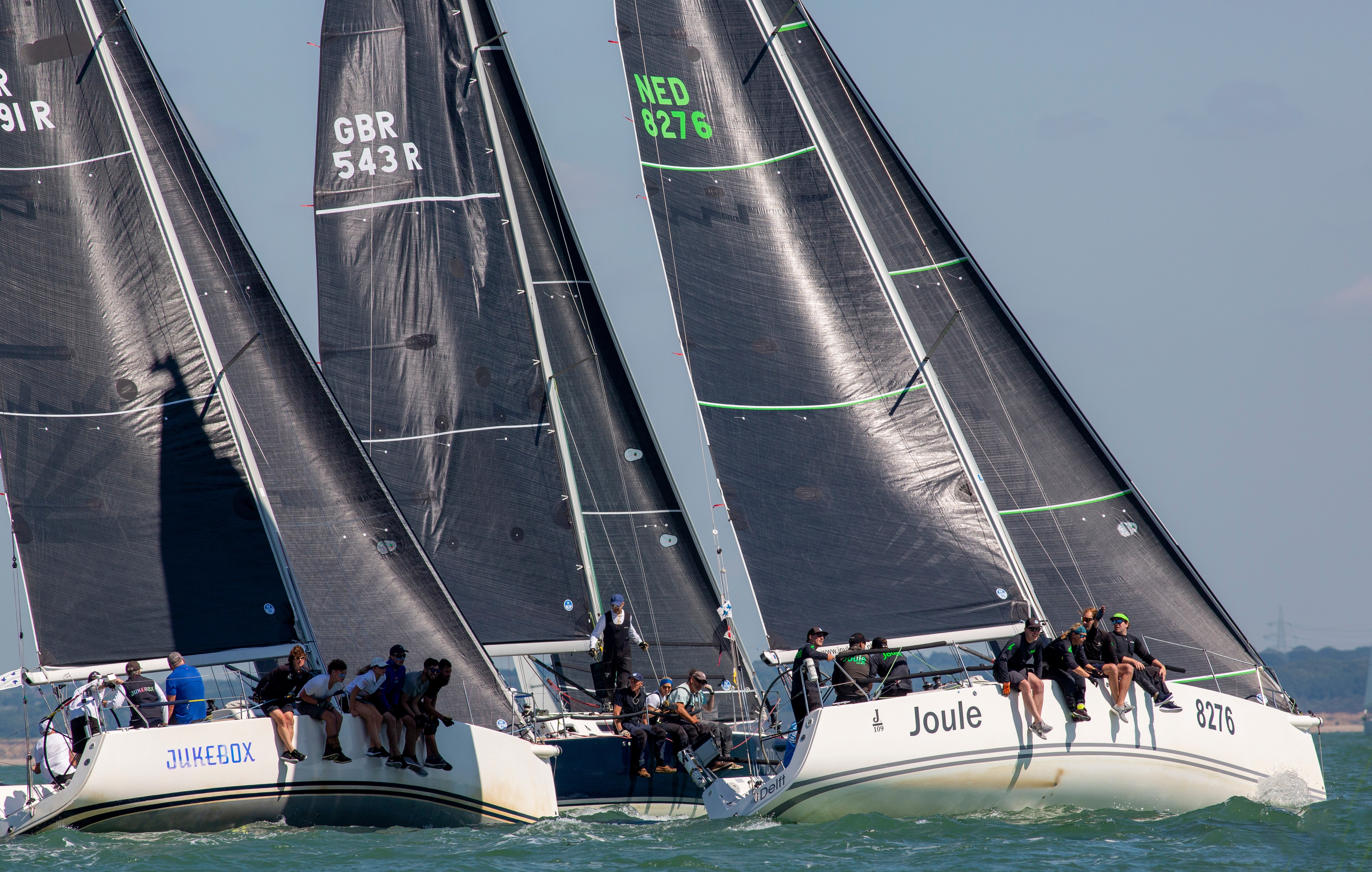
IRC tweaks for a J109: bigger genoa, Code Zero… or a flying headsail?
If you sail a J109 under IRC you quickly discover that every sail change is a trade: a bit more raw speed in exchange for a bit more handicap number. The trick is spending your “rating budget” where it actually wins you races, not just feels nicer on the helm.
Three upgrades tend to come up:
- 120% overlapping genoa -> there must be something useful we can do with all those overlapping headsails we still have in the loft from back in the day …
- Code Zero as an extra spinnaker
- Flying jib / flying headsail set off the bowsprit, possibly with the forestay jib still up
On paper, all of them make the boat faster in some part of the wind range. But they cost very different amounts under IRC – and they help on very different parts of the race course.
This article walks through the numbers, the real-world gains, and why, for most J109 (other boat classes are available) programmes, spending rating on an extra spinnaker slot for a Code Zero usually offers better value than paying for a big genoa – and where flying jibs / flying headsails slot in as an alternative or complement.
What does a higher IRC number actually cost?
IRC Ratings are a way to let dissimilar boats race against each other on the same course. Each boat receives a handicap number based on its configuration; size, weight, sail area and so forth.
An IRC corrected time is calculated by multiplying the boats Elapsed Time around the course by a Time Corrector (TCC) also known as the IRC rating.
Raise the TCC and you owe more corrected time to the slower boats for the same elapsed time.
For example if the TCC goes from 1.005 to 1.012 for every hour of racing your corrected time will be 25 seconds per hour bigger/longer. If your boat speed doesn’t change you’re 25 seconds per hour slower on corrected time than you used to be.
For typical race durations, if the TCC goes from 1.005 to 1.012 that’s roughly:
- 2-hour race → you “owe” an extra 50 seconds
- 3-hour race → ~75 seconds
- 4-hour race → ~1 minute 40 seconds.
So for a 5 day Fastnet race thats nearly an hour you are potentially giving away to a boat with a lower handicap.
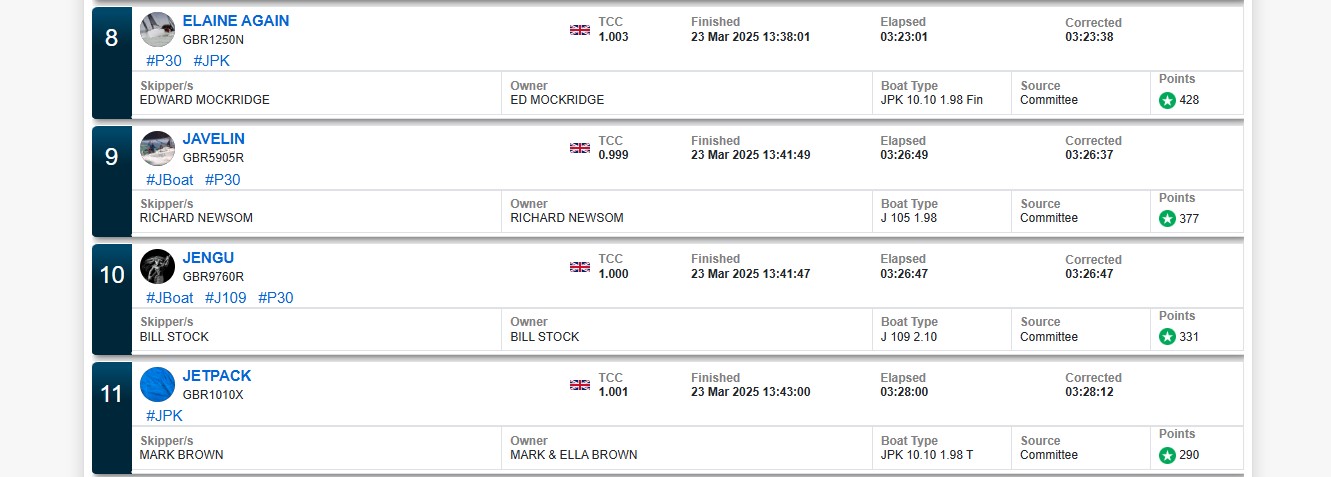
OK so that doesn’t sound a lot but races can be close; for example, the 2025 JOG Great Escape Race two minutes separated Javelin, Jengu and Jetpack. Javelin finished 2 seconds after Jengu but has an IRC Rating .001 less than Jengu so in a three and half hour race Javelin beats Jengu by 10 seconds on corrected time. If Jengu’s TCC value had been .999 (.001 lower) they would have beaten Javelin.
To break even, your new sail plan needs to get you around the course that much faster in real time.
You can reframe that as a speed requirement:
Speed_new = Speed_old × (1.012 / 1.005) ≈ Speed_old × 1.007
So you need to average about 0.7% more speed around the whole course to see the value of the higher rating number. Keep that number in the back of your mind. Everything below is basically looking at the question: does this sail configuration give us at least ~0.7% gain on average?
120% genoa on a J109 – where it helps and where it doesn’t
The current standard J109 IRC / One Design setup uses a non-overlapping headsail (around 105%). Back when we started sailing a J109 back in the late 2010’s the One Design rules allowed a larger overlapping headsail configuration. The class went to smaller headsails formally in 2018.
To be honest the crews didn’t seem to miss wrestling the massive headsails through the tacks; especially in the typical short tacking battles you get racing in the Solent; short tacking a 140% Genoa from New Town Creek to Yarmouth to stay out of the tide the jib trimmers earned their beer. I suspect most of the existing J109 No 1 and No 2 headsails now reside in peoples lofts; ours hasn’t been out on the water in a while.
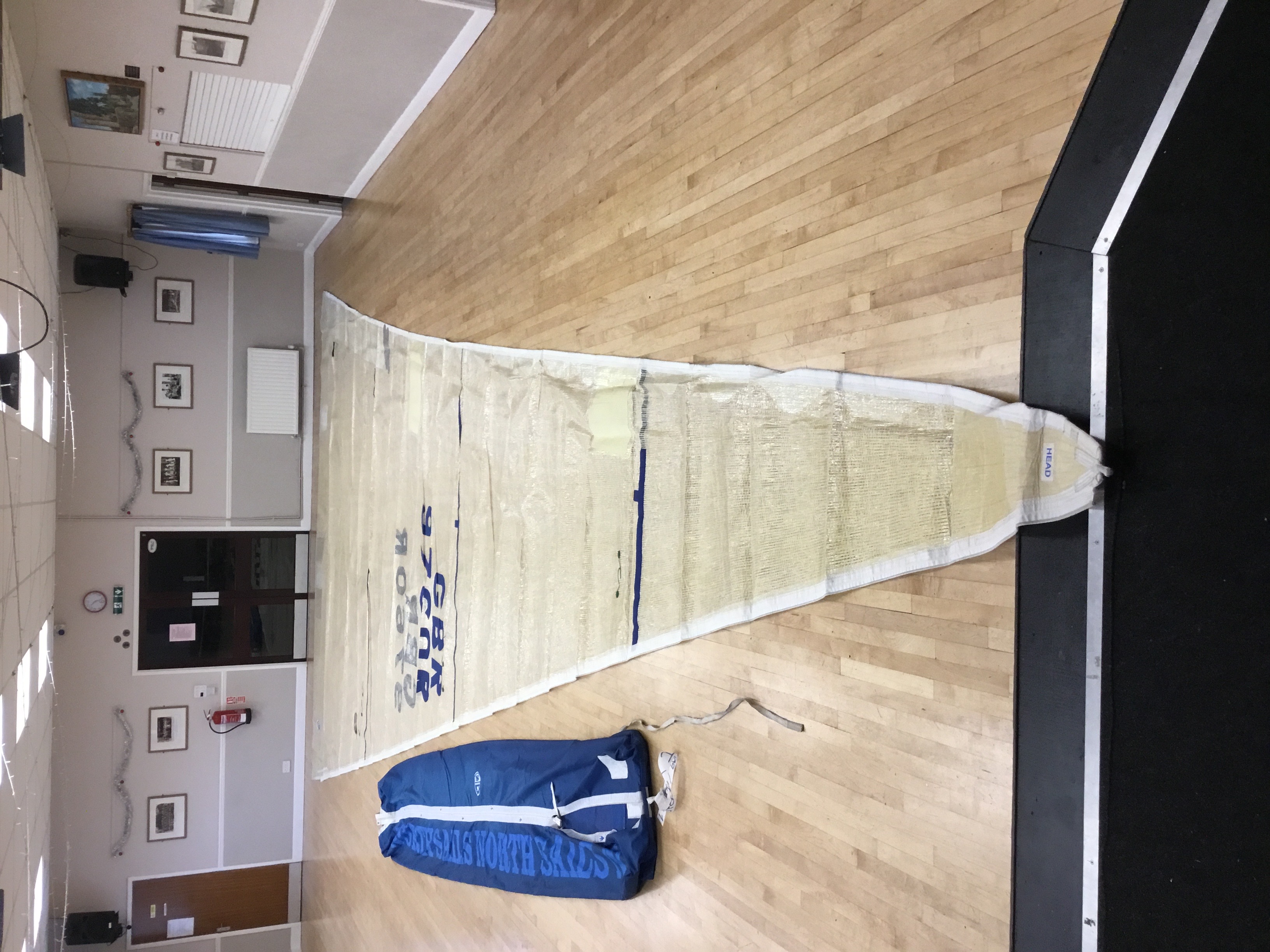
Going back to a 120% genoa for longer offshore races sounds like “free horsepower” – and in light to low-medium upwind, it more or less is.
Crunching the numbers in Excel.
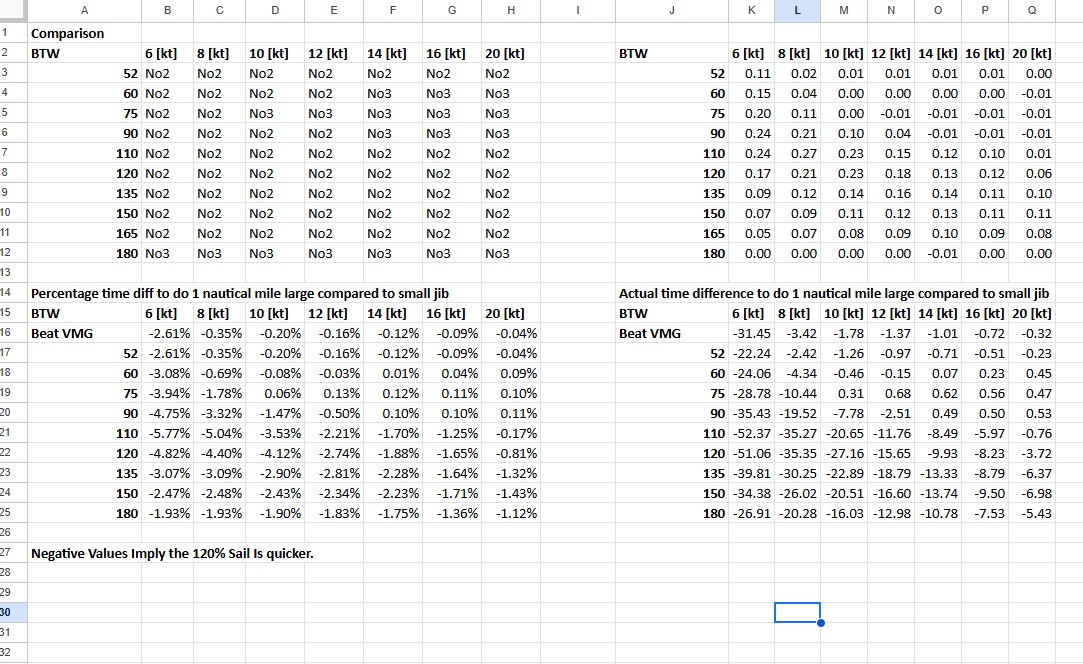
We take the boat polar data for the 105% Jib and 120% Genoa and estimate the time to travel a nautical mile. We then apply the appropriate TCC to those numbers. The screen shot below is for the 105% Jib. We build the same model for the 120% Genoa.
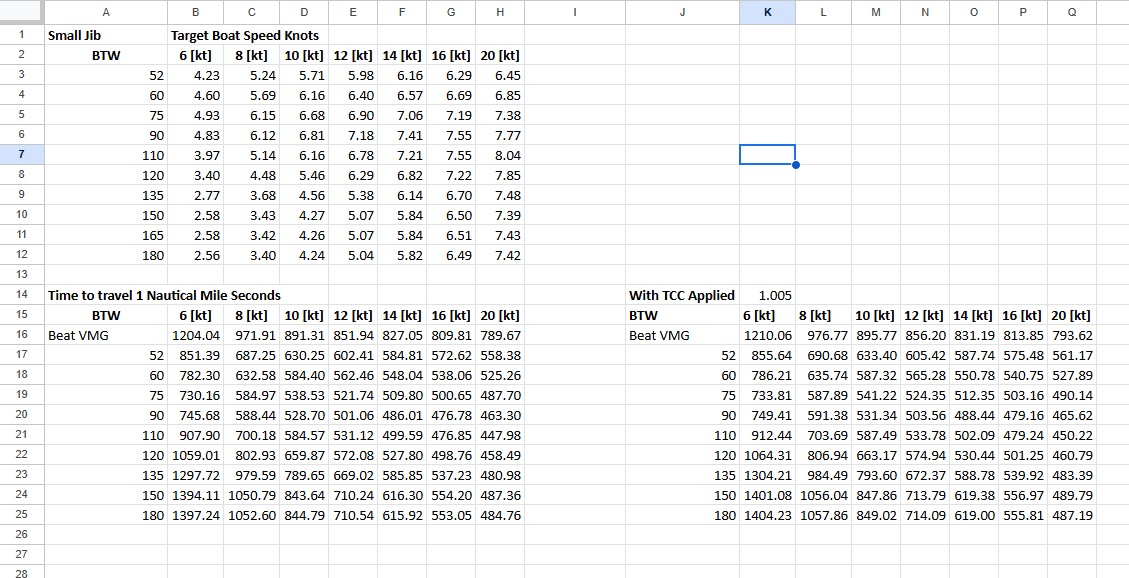
Comparing the numbers we can work out where the bigger sail adds value.
Where the 120% Genoa helps
Upwind and tight fetches, particularly when:
- True wind is in the 6–10 knot range, and
- The standard jib is still a bit under-powered.
In that band you’ll see:
- Better acceleration out of tacks
- Better ability to hold height without sagging
- A couple of percent more boat speed upwind
Realistically, you might see something like 2–4% faster upwind in 6–9 knots when you’re actually using the 120%. On those legs, that comfortably beats the 0.7% “break-even” requirement.
Where the 120% Genoa doesn’t do much
Once you’re at 12+ knots, the J109 is pretty happy on the standard jib. Extra overlap becomes more about heel and handling than speed. On most reaches and runs, you’re back on jib and spinnakers.…which are the same sails you had before.
But you still pay +0.007 TCC all the time – including on:
- Windy windward–leewards where you revert to the small jib, and
- Reaching / downwind-biased coastal races where the genoa stays in its bag.
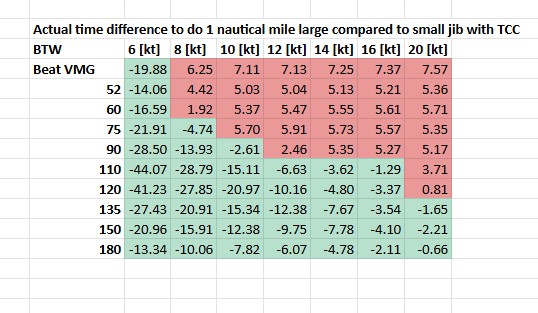
So the real question isn’t “does it make the boat quicker?” (it does) – it’s:
Does it give enough average gain over a season to justify +0.007?
To answer that one you need to understand what the weather is going to do over a season. If you sail somewhere windy then the large headsail doesn’t help but if you sail somewhere the average wind speed is in the 6-8kt range then its worth thinking about. The graph below is from the UK Met Office website and shows average wind speed in the Solent. For most of the year the wind speed is well outside that 6-8kt target.
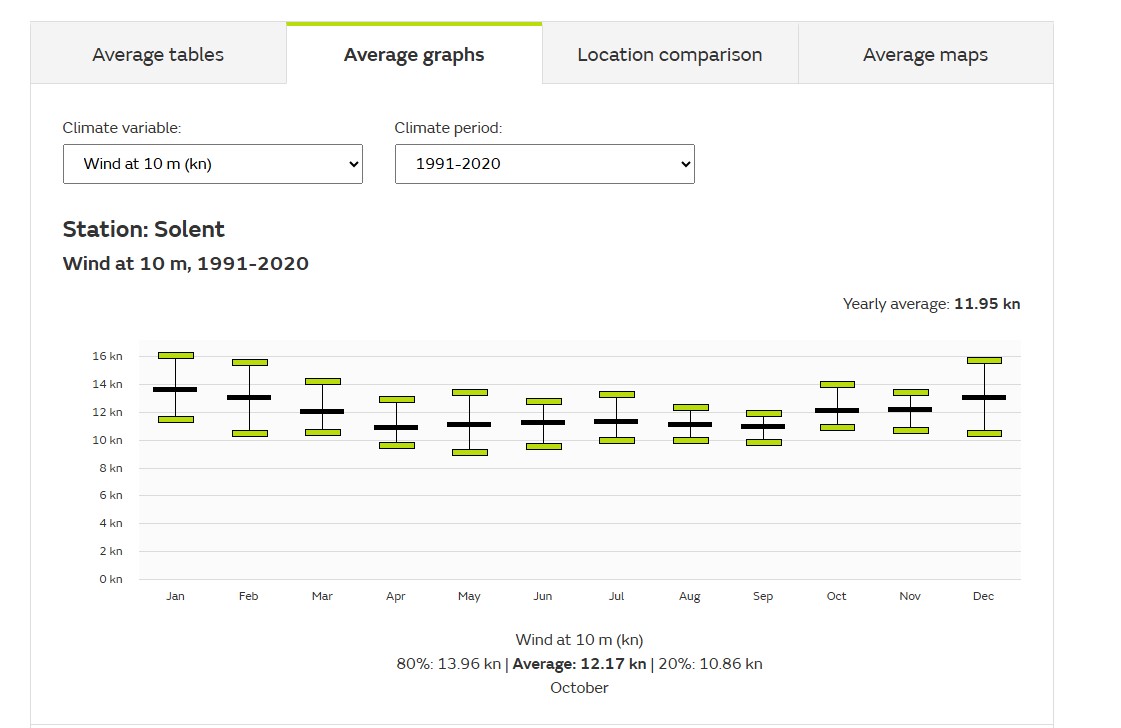
See metoffice.gov.uk for more info.
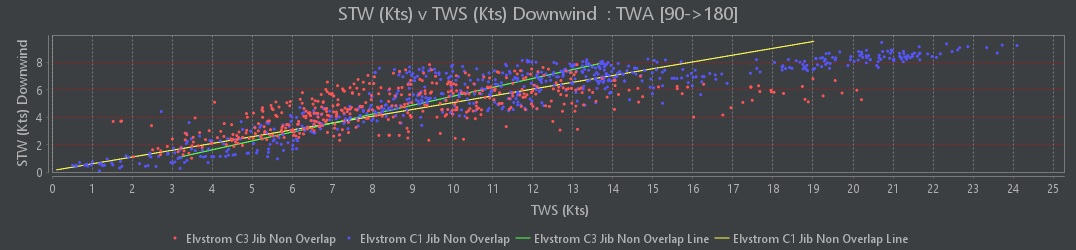
Finally to validate the calculations we use Rockit our data analytics package to collect data about the performance of the sails that we use. This helps us validate the values we expect to see; if the VPP Polar data for a sail says to expect 6.5knots boat speed at 30AWA we can collect data as we sail and validate the results using the graphing functions within the software package.
Code Zero as an extra spinnaker – big gains for a small rating hit
Now let’s look at spending rating on a Code Zero.
Under IRC, the downwind side is driven by:
- SPA – the area of your largest spinnaker.
- The total number of spinnakers carried.
So if you build your Code Zero so that it meets the spinnaker definition (mid-girth ≥ 75% of foot) and its area is smaller than your biggest existing kite you will simply increase your spinnaker count.
The “4th spinnaker” hit is usually in the order of +0.001–0.002 TCC (about 1–2 rating points).
That translates roughly to:
- +0.001 → ~3.6 seconds per hour
- +0.002 → ~7.2 seconds per hour
Compare that with +25 seconds per hour for the 120% genoa: the Code Zero is 4–7 times cheaper in rating terms.
Where the Code Zero shines on a J109
A Code 0 fills the big gap between the jib and an Asymmetric Spinnaker like a A2 or A3.
It’s the weapon of choice for light to medium reaches where the jib is under-powered and the Asymmetric won’t stand up without you needing to sail deeper. “Up-and-in” angles in light airs – those horrible 50–80° TWA legs in 5–9 knots. In those modes, a J109 can see dramatic improvements in VMG compared to jib alone. It’s not unusual to be a full knot or more faster than “jib only” at certain angles when it’s light.
You won’t hoist it every leg, but when you do, it can easily deliver minutes of gain relative to your old setup and you’re paying a tiny 3–7 seconds per hour in rating to have that gear available.
Its also worth saying that you will need to practice hoisting it… with a furler its a lot from complicated to set than the Asymmetric you hoist out of the hatch; though in some scenarios you can leave the furled Code Zero up while you sail a higher angle then unfurl it again as the breeze shifts.
Flying jibs and flying headsails – what’s the difference?
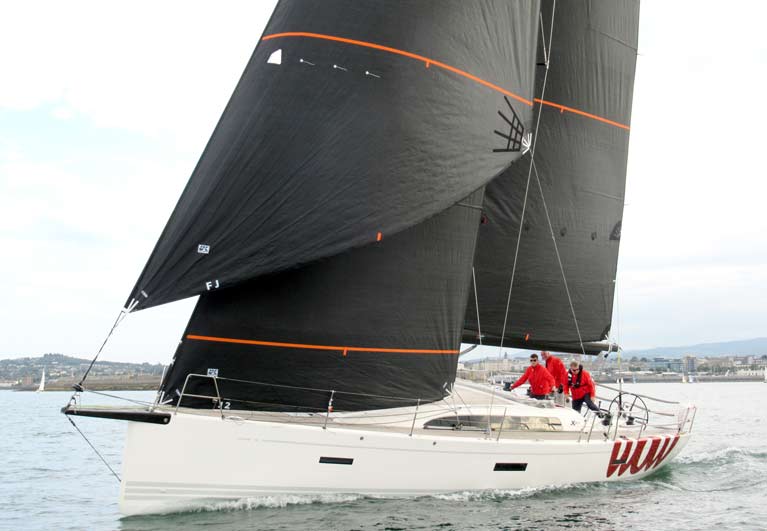
There’s a lot of confusion around terminology, so let’s split it into two distinct things:
- Headsail set flying (often called a flying jib or staysail in normal sailing language)
- IRC-defined “Flying Headsail” (a distinct IRC sail type)
The image at the top of this section is credited to Afloat.ie and UK sails excellent article here; Afloat.ie
Headsail set flying (flying jib)
From 2024 onwards, IRC looks at the number of headsails on board, including:
- Normal forestay jibs
- Staysails
- Jibs set flying off the bowsprit
Any sail that measures as a headsail (within your HSA / HLU max limits) is counted in the headsail number – including staysails and jibs set flying, even if they’re not on the forestay. You may tack a headsail forward of the forestay and set it flying up to STL without it becoming a Flying Headsail, as long as it fits within HSA / HLU max. All those headsails – forestay jib, staysail, flying jib – are part of your headsail count.
The number of headsails on board is now rated. Carrying extra jibs increases TCC slightly. On a mid-size boat like a J109, that tends to be on the order of +0.001 TCC per extra headsail, though the exact figure depends on your specific inventory.
So for your J109: If you go from “just the working jib” to “jib + flying jib”, and you declare that additional headsail: Expect something like 1.005 → ~1.006 (ballpark); that’s ~3–4 seconds per hour in rating.
Where a flying jib helps
- Tight reaches and cracked-off upwind in 6–15 knots:
- The forestay jib keeps the slot full.
- The flying jib adds more projected area forward and outboard.
Effectively, it gives you a double-headed reaching mode that sits between “jib only” and “full Code Zero”.
Key rule point: double-headed is already “priced in” The rule says you must not carry more headsails than are on your certificate, but headsails may be set simultaneously. You’re charged in rating for the number of headsails declared. Once you’ve paid for, say, 2 or 3 headsails, you’re allowed to stack them (jib + flying jib together). There’s no extra hidden penalty for using them at the same time – the double-headed reaching configuration is exactly what the headsail-count rule is designed to capture.
IRC-defined Flying Headsail
Then there’s another newer category: the IRC Flying Headsail – a distinct sail type defined by mid-girth and how it’s set (tacked forward of the forestay, set flying).
For a J109, published examples suggest that a single Flying Headsail of around 60 m² might cost on the order of +0.005 TCC. Flying headsails are not counted as headsails for the headsail-count rule; they live in a separate “number of flying headsails” bucket and are rated accordingly. You can set headsails (like staysails) at the same time as a Flying Headsail, as long as those other sails stay within your normal headsail area/luff limits.
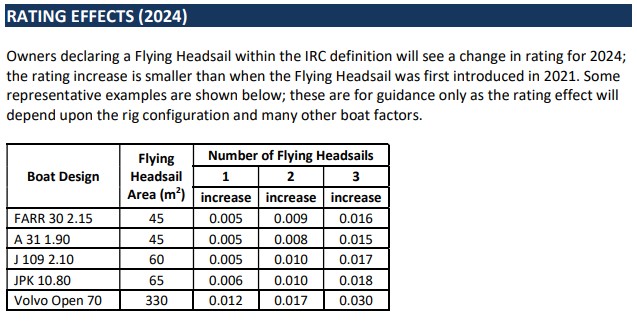
Source : ircrating.org
Where do Flying Headsails make sense?
On a J109, the flying-headsail approach tends to make more sense when:
- You’re optimising for a very specific reaching / offshore programme,
- You’re already spending rating elsewhere and want very precise sail shapes between jib and Code 0.
But when you look at an example +0.005 TCC for a single J109 Flying Headsail, you’re getting close to the 120% genoa hit (+0.007); much more than the extra-spinnaker Code 0 hit (+0.001–0.002). So in “seconds per rating-point” terms, a big dedicated Flying Headsail is a relatively expensive toy unless your race calendar is very reach-heavy and you know you’ll use it constantly. Its unlikely to be useful for anything originating on the UK South Coast; with the prevailing South Westerly breeze most of the year you are likely to spend a lot of time on a either a broad reach or a beat/close reach.
Comparing the options – where would you spend the rating?
Let’s line them up.
120% overlapping genoa
- Rating cost: ≈ +0.007 TCC (~25 s/hour).
- Gains: mainly light to low-medium upwind / tight fetch.
- Minimal benefit in powered-up breeze or on most reaches and runs.
Verdict: big rating bill for a relatively narrow performance band.
Code Zero as an extra spinnaker
- Rating cost: ≈ +0.001–0.002 TCC (3–7 s/hour).
- Gains: huge in light/medium tight reaches and “up-and-in” downwind modes.
Verdict: small rating bill for a big, high-impact extra gear in exactly the modes where J109s often struggle.
Flying jib (headsail set flying) + forestay jib (double-headed)
- Rating cost: via extra headsail count, typically ≈ +0.001 TCC per extra jib on a mid-size boat.
- Gains: double-headed reaching mode in 6–15 knots; more subtle than a Code 0, but simpler to engineer and can stay within headsail rules if you keep area ≤ HSA and luff ≤ HLUmax.
Verdict: a good “middle step” – more modes for a modest rating bump, particularly useful if you want extra torque on tight reaches without going full Code 0.
IRC Flying Headsail (capital F, capital H)
- Rating cost (example): on a J109, 1 flying headsail around 60 m² might be ~+0.005 TCC.
- Gains: very efficient reaching / off-wind performance; can be used with other headsails set at the same time.
Verdict: a powerful but rating-expensive option. It starts to look like the “premium” choice for boats with very reach-heavy programmes and deep optimisation budgets.
So what makes most sense for a J109 under IRC?
Every boat and venue is different, but for a typical J109 IRC programme:
- If your important races have lots of reaching and coastal legs; Spend the rating first on a Code Zero as an extra spinnaker. It’s cheap in TCC, and the gains can be huge.
- If you want more modes without going fully down the Code Zero / Flying Headsail route; consider a flying jib (headsail set flying) that stays inside your HSA / HLU max limits. Declaring one extra headsail for a double-headed reaching mode is often a sensible, modest step.
- If your racing is mostly short, breezy W/Ls; the 120% genoa becomes harder to justify when you look at how often it’s actually used vs. how much rating it costs. Extra reaching sails may see limited use too – sometimes the best rating is no extra sails at all.
- If you’re tempted by a full IRC Flying Headsail; treat it as a deliberate, high-impact optimisation, not a casual add-on. For a J109 the example +0.005 TCC is very noticeable – it needs to deliver serious gains on your key courses to earn its keep.
And whichever combination you’re considering, the final sanity check is always the same:
Ask the Rating Office for trial certificates – one with the 120% genoa, one with the Code Zero as a spinnaker, one with a flying jib (extra headsail), and, if you’re going that way, one with an IRC Flying Headsail. You’ll then have hard TCC numbers to sit alongside your polars, race logs and gut feel – and you can decide where your rating budget delivers the most real-world seconds on the water.
Credits
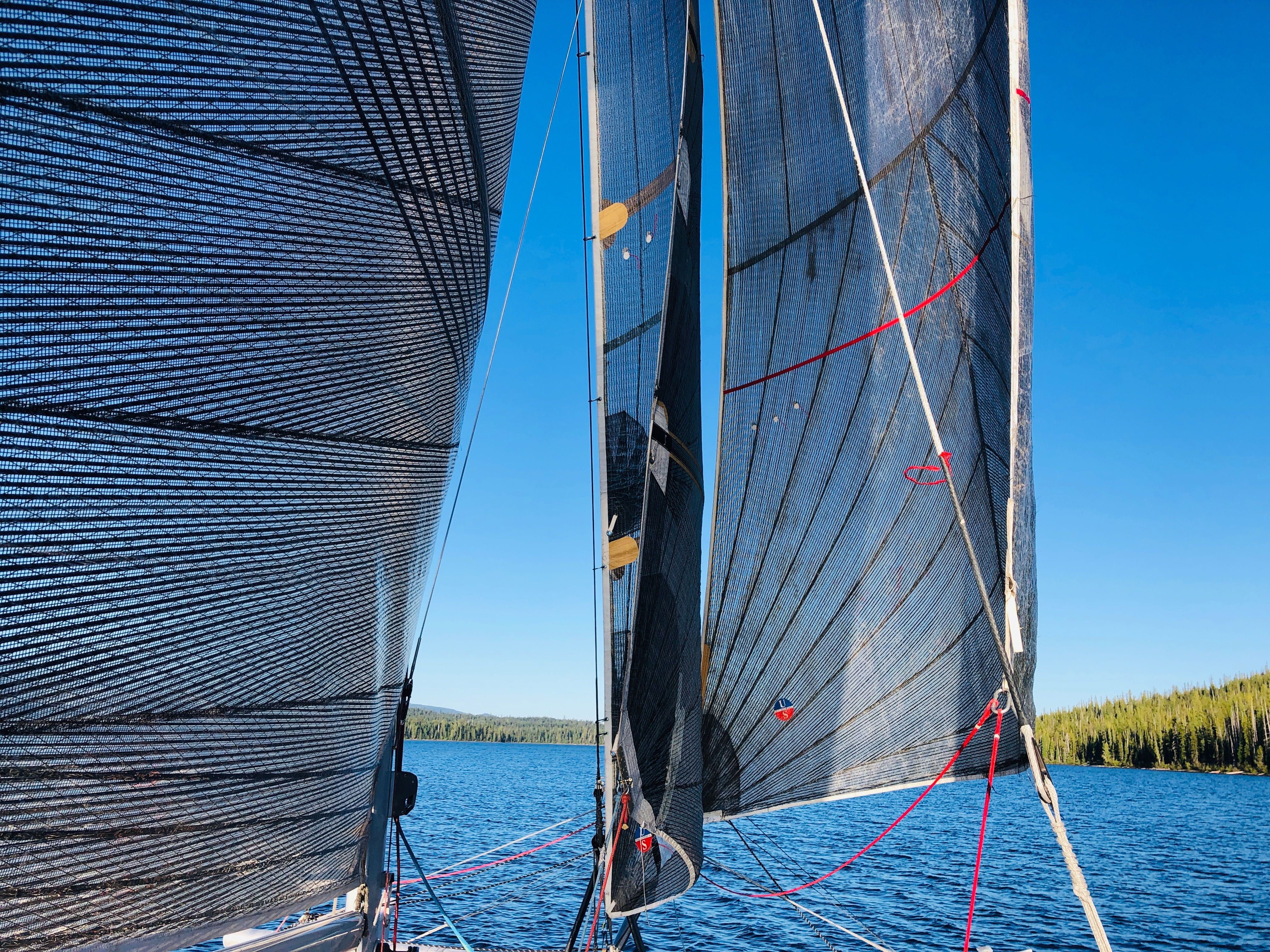
Thanks to Peter and co at Sanders Sails for advice comparing the Code Zero to the Flying Jibs and letting us use the Code Zero sail image on the cover for this article. It was surprisingly difficult to find a photo of someone using a Code Zero in real life presumably because they are primarily an offshore sail.
You can find out more about our Rockit software package on this website. If you want to know more get in touch using the link below.